
Beyond Surface-Level: Why Electrohydraulic Shockwave Therapy Outperforms Other Modalities for Acute and Chronic Healing
- Qarib Ahmed
- Jul 9
- 5 min read

If you’ve been researching shockwave therapy, you’ve probably noticed there are different types — radial, piezoelectric, electromagnetic, electrohydraulic — and it can get confusing fast. The term “shockwave” gets thrown around loosely, but not all devices are created equal. In fact, most devices on the market aren’t true shockwaves at all.
Let’s break down what actually matters when it comes to healing, whether you’re dealing with a fresh injury or something that’s been lingering for years.
Radial vs. True Shockwave: Not the Same Thing
Radial pressure wave therapy is the most common type you’ll find in clinics. It works by using compressed air to propel a projectile against an applicator, creating a pressure wave that spreads outward radially — like a ripple in a pond. The energy starts strong at the surface but dissipates quickly as it travels deeper.
Radial devices are not true shockwaves. They produce lower peak pressures and significantly slower rise times. The energy stays mostly superficial, making them better suited for larger, surface-level areas like muscle tension in the back or thighs. They’re also generally less precise — the energy fans out rather than focusing on a specific point.
Electrohydraulic shockwave, by contrast, is the original and true shockwave technology. Here’s how it works: a high-voltage spark vaporizes a small amount of water inside the handpiece, creating a plasma bubble that collapses almost instantly. That collapse generates a focused acoustic wave traveling at over 3,300 mph — faster than the speed of sound. An ellipsoid mirror inside the device directs that energy precisely to the target depth, whether that’s a tendon, ligament, or fascia.
This is the technology I use with the OmniWave device as a GAINSWave-certified practitioner. It delivers high-intensity energy exactly where it’s needed, with minimal discomfort.
The Key Differences at a Glance
Feature | Radial (Pressure Wave) | Electrohydraulic (True Shockwave) |
Energy type | Surface-level pressure wave | Focused acoustic shockwave |
Peak pressure | Low to moderate | High |
Depth of penetration | Superficial (muscle-level) | Deep (tendons, ligaments, bone) |
Precision | Diffuse, spreads outward | Focused, targeted |
Rise time | Slow | Fast (true shockwave) |
Best for | Muscle tension, large areas | Tendinopathies, chronic conditions, precise targets |
Why True Shockwave Excels for Acute Injuries
Acute injuries — a partial muscle tear, a strained tendon, a sudden onset of pain — involve tissue damage and an immediate inflammatory response. The body knows what to do, but it can be slow, inefficient, or stuck in a cycle of inflammation without progressing to repair.
Electrohydraulic shockwave accelerates this process in a way radial therapy simply can’t match. The focused energy penetrates to the exact depth of the injured tissue and triggers a cellular response:
Cell membrane deformation signals the body that healing needs to happen
ATP release provides energy for repair processes
Growth factors like VEGF, TGF-β1, and IGF-1 are activated
Blood flow increases to the area, bringing oxygen and nutrients
For acute injuries, patients often feel a noticeable shift within the first few sessions. The 5-7 minute treatment time means it fits easily into a busy schedule, and because I’m mobile, there’s no commute to a clinic.
Where True Shockwave Really Shines: Chronic Conditions
Chronic conditions are a different animal. Plantar fasciitis that’s been nagging for two years. Tennis elbow that won’t quit. Achilles tendinopathy that sidelines you from the activities you love. These conditions persist because the body has stopped trying to heal — it’s settled into a state of low-grade inflammation and disorganized tissue.
This is where electrohydraulic shockwave separates itself from every other modality.
The high-energy focused wave does something remarkable: it wakes up the healing process. The mechanical force creates micro-damage in chronic, disorganized tissue, which signals the body to break it down and rebuild it properly. But more importantly, it triggers the body’s own regenerative machinery.
Here’s the stem cell activation pathway:
The shockwave deforms cell membranes → ATP releases → growth factors fire (VEGF, TGF-β1, BMP-2, IGF-1) → chemokine gradients form → your mesenchymal stem cells home to the site, dock, multiply, and differentiate into the tissue you need — tendon, ligament, blood vessel, or bone.
No injection. No lab. No risk of rejection. Your body heals itself using its own cells.

The Regeneration Timeline
Timeframe | What Happens |
Seconds | Cell signaling cascade begins |
0–48 hours | Growth factor production; stem cell homing signals released |
Days 2–7 | Stem cells arrive and proliferate at the treatment site |
Weeks 1–3 | Stem cells differentiate; new vessels form; pain decreases |
Weeks 3–8 | Tissue remodels — most patients feel the shift here |
Months 2–6 | Full maturation and tissue integrity restored |
This timeline explains why chronic conditions often need 4-6 sessions, and sometimes up to 10-14 for stubborn cases. The body is being asked to rebuild tissue that’s been dysfunctional for years — that takes time. But unlike cortisone shots that mask the pain or surgery that comes with downtime and risk, shockwave addresses the root cause.
Comparing to Other Modalities
Radial pressure wave — As discussed, this is a surface-level tool. It can provide temporary relief for muscle tension and may have some benefit for larger, superficial areas. But it lacks the depth, precision, and true shockwave characteristics needed to stimulate deep tissue regeneration. Many clinics use radial devices because they’re cheaper, but patients aren’t getting the same treatment.
Piezoelectric shockwave — These devices generate shockwaves using crystals that vibrate when an electrical current is applied. They produce true shockwaves, but the energy is typically lower intensity and spread across a wider area rather than focused to a precise point. They can be effective, but lack the concentrated power of electrohydraulic technology.
Electromagnetic shockwave — Uses magnetic coils to generate a shockwave. These devices can produce true shockwaves with good depth penetration, but they tend to be bulky, expensive, and less comfortable for patients. The energy delivery is also less precise than electrohydraulic focusing.
Electrohydraulic shockwave — The gold standard. Highest peak pressure, most precise focusing, deepest penetration, and the most comfortable patient experience when using a modern device like the OmniWave. It’s the only technology that combines true shockwave characteristics with pinpoint accuracy and patient comfort.
Why I Chose Electrohydraulic (OmniWave)
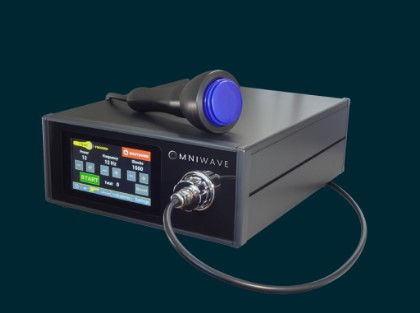
I didn’t choose this technology because it’s the most expensive or the most impressive on paper. I chose it because it gives my patients the best results.
The OmniWave device is widely regarded as one of the most comfortable high-intensity shockwave devices available. The 5-7 minute treatment sessions are quick, well-tolerated, and produce measurable results — whether for a weekend warrior with acute hamstring pain or someone who’s been living with chronic plantar fasciitis for years.
And because I’m a mobile practice serving Fairfield and New Haven counties, you get this advanced technology in the comfort of your own home. No waiting rooms, no travel time, no rushing to make an appointment fit into your day.
Is Shockwave Right for You?
Shockwave therapy is effective for a wide range of conditions:
Plantar fasciitis
Tennis and golfer’s elbow
Achilles tendinopathy
Rotator cuff issues
Patellar tendinopathy
IT band syndrome
Back and neck pain
And many other musculoskeletal conditions
It’s not appropriate for everyone — contraindications include pregnancy, active cancer, and children under 18 — but for most people dealing with acute or chronic musculoskeletal pain, it’s one of the most effective non-invasive options available.
Ready to see if electrohydraulic shockwave can help you? I offer free 15-minute phone consultations to discuss your condition and determine if this approach is right for you. If you’re in Fairfield or New Haven County, I’ll come to you.
Comments